Keyboard Music of J. S. Bach
Why do I play Bach?
Getting to know Bach
 When I
was a child, I was already fond of Bach's music. I hated Czerny's
and practiced it only reluctantly but I really enjoyed practicing Inventions
& Symphonias. I was attracted by polyphonic music in which multiple melodic
lines are entwined intricately instead of simple
homophonic structure consisting of melodies and chords. Particularly eye-opening
were "Partitas" played by D. Lippati and "Italian Concerto" by G.
Gould which I played in a recital when I was of elementary school age.
When I
was a child, I was already fond of Bach's music. I hated Czerny's
and practiced it only reluctantly but I really enjoyed practicing Inventions
& Symphonias. I was attracted by polyphonic music in which multiple melodic
lines are entwined intricately instead of simple
homophonic structure consisting of melodies and chords. Particularly eye-opening
were "Partitas" played by D. Lippati and "Italian Concerto" by G.
Gould which I played in a recital when I was of elementary school age.
The ever-changing chords and tonality are some of the allures of Bach's
music in which melody patterns of similar configurations often present
themselves under different tints. I
have been very fond of "sequences". Although expressive sequences are
seen even in Mozart's piano concerts or Wagner's works, Bach's works
are full of sequences because they are often inherently incorporated in
the system of Bach's music,including most of is passing passages.
In
retrospect, I have played Bach's music at every momentous step in my
caeer. I played Bach in my first appearance on a TV program in my
childhood. I played "Partita No. 5" at the recruitment exam of Professor
Yoshie Kohra, my former teacher. If she had not accepted me as a
pupil at that time, I would not be who I am now. Later, I played
"Chromatic Fantasy and Fugue" for a scholarship to study in Germany.
My Favorites
The twin
jewels of Bach's keyboard works are "Goldberg Variations" and "Well-
Tempered Clavier 1/2". "Goldberg" is a piece into which Bach's genius is
miraculously condensed. Since I heard the recording of the piece by G. Gould,
I hoped to play it in due time. Wehn I played it in my recital about 10
years ago, and I became really overwhelmed by its elaborate and logical
structural beauty. I felt euphoric just reading and analyzing the score.
I would highly recommend all piano learners to challenge it.
"Well-Tempered" is the most enjoyable work to play because of its wide
varieties in tonality, character, and style, together with the distinct
contrast between preludes and fugues in each piece. Bach's other three
suites are also fine but it is necessary not play monotonously due to
their lack of variation in tonality.
Relationship with contemporary music
An often asked question is whether there is a denominator between Bach's
music and contemporary music because I have played both
in the past. It may not be necessary to correlate them but suffice to say that
there may be some common factors. Schönberg's works are mostly
contrapuntal and Stockhausen employed contrapuntal technique
occasionally, for example. Both are logically beautiful in nature, but
there is often an unfortunate dissociation between logical beauty in
composition and acoustic impression in Stockhausen's works, while they
are in perfect accordance in Bach.
Playing Bach's works on piano
Although modern pianos were not
available in Bach's era, I believe that his keyboard works have very good
chemistry with modern pianos. Chopin wrote music exclusively for
modern pianos. Bach also wrote some works with "pianistic language" in
mind and they had influence over Chopin’s works such as his Etudes.
Bach transformed many works such as chorales, baroque concerts,
passions, and trio sonatas into keyboard works. These would be perfectly
suitable for modern piano which is often called an orchestral instrument.
Pianists have wide room for creativity in their performances.
Piano sonatas by Beethoven and Mozart also have orchestral aspects. Well-
Tempered Clavier II by D. Barenboim was very colorful, almost as if it were
an orchestral work. However, a contrary approach may be possible - an
approach that emphasizes mathematical and abstract beauty while
restraining the colorful aspect of the music, an inclination that is seen
in "Well-Tempered" by G. Gould.
In Bach's
era, the principal keyboard instruments were the organ and harpsichord.
With harpsichord, essentially lacking dynamic control, the player has to
add expressions to the music through the use of agogics, rubato
and other temporal parameters.
The lavichord, capable of dynamic control and compatible
legato technique, was already available those days, but it was not widely
used because of its relatively small sound. The piano in which the player
has full control of dynamics, is the best instrument for Bach's music.
I believe Bach's music is better expressed to its utmost extent on piano
in the mode of technique and expression different from his days.
On the repeat in Bach's works
 An repeat is designated at the end of
the first half and the second half of Bach's
suites, Goldberg, and a part of Well-Tempered (in particular the preludes
of Book 2). To repeat or not may be a question, although there is a
dogged opinion that following the repeat is a must. I feel that it should be at the
discretion of the pianist, particularly in the suites. In Bach's era, the
opportunity to hear the same music many times was so infrequent that it must have been
necessary to repeat the phrases in order to impress them to the audience.
Nowadays, with much more frequent chances of attending concerts
and the availability of electronic devices,
pianists should repeat only when they feel that repeating enhances the artistic
experience.
An repeat is designated at the end of
the first half and the second half of Bach's
suites, Goldberg, and a part of Well-Tempered (in particular the preludes
of Book 2). To repeat or not may be a question, although there is a
dogged opinion that following the repeat is a must. I feel that it should be at the
discretion of the pianist, particularly in the suites. In Bach's era, the
opportunity to hear the same music many times was so infrequent that it must have been
necessary to repeat the phrases in order to impress them to the audience.
Nowadays, with much more frequent chances of attending concerts
and the availability of electronic devices,
pianists should repeat only when they feel that repeating enhances the artistic
experience.
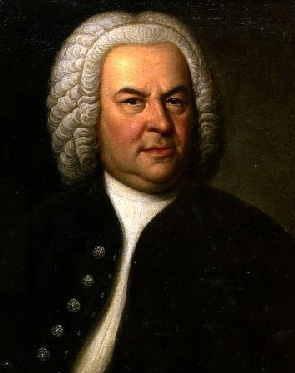
J.S.Bach (1685-1750)
Recommended Diskography for J. S. Bach's Keyboard works
Well-tempered Clavier 1, 2 (S. Richter)
Well-tempered Clavier 1, 2 (E. Fischer)
Goldberg Variations (G. Gould, 1981)
Goldberg Variations (G. Gould, 1985)
Gould has eliminated religious elements nearly completely from Well- Tempered and thus, I feel, has transmuted it or made it less artistic On the contrary, as for Goldberg, his approach of emphasizing mathematical integrity over religious aspects seemed to be successful in maximally eliciting the value of this great work.